
 English
 日本語
日本語
 한국어
한국어
 Dansk
Dansk
 Nederlands
 Italiano
 Español
 Árabe
Árabe
 Português
 Türkçe
 Deutsch
 Русский
 Français
 Prancis
 ไทย
ไทย
 Tiếng Việt
 हिंदी
हिंदी
 বাংলা
বাংলা

Advanced Die & Stamping
Technical Capabilities
Delivering precision-engineered tooling solutions that reduce time-to-market, lower total cost of
ownership, and meet the quality benchmarks of Tier-1 automotive OEMs worldwide.
| 95%+ | <±0.05 mm | 40% | ISO 9001 |
| On-Time Delivery | Dimensional Toleranc | Lead-Time Reduction | Quality Certifi |
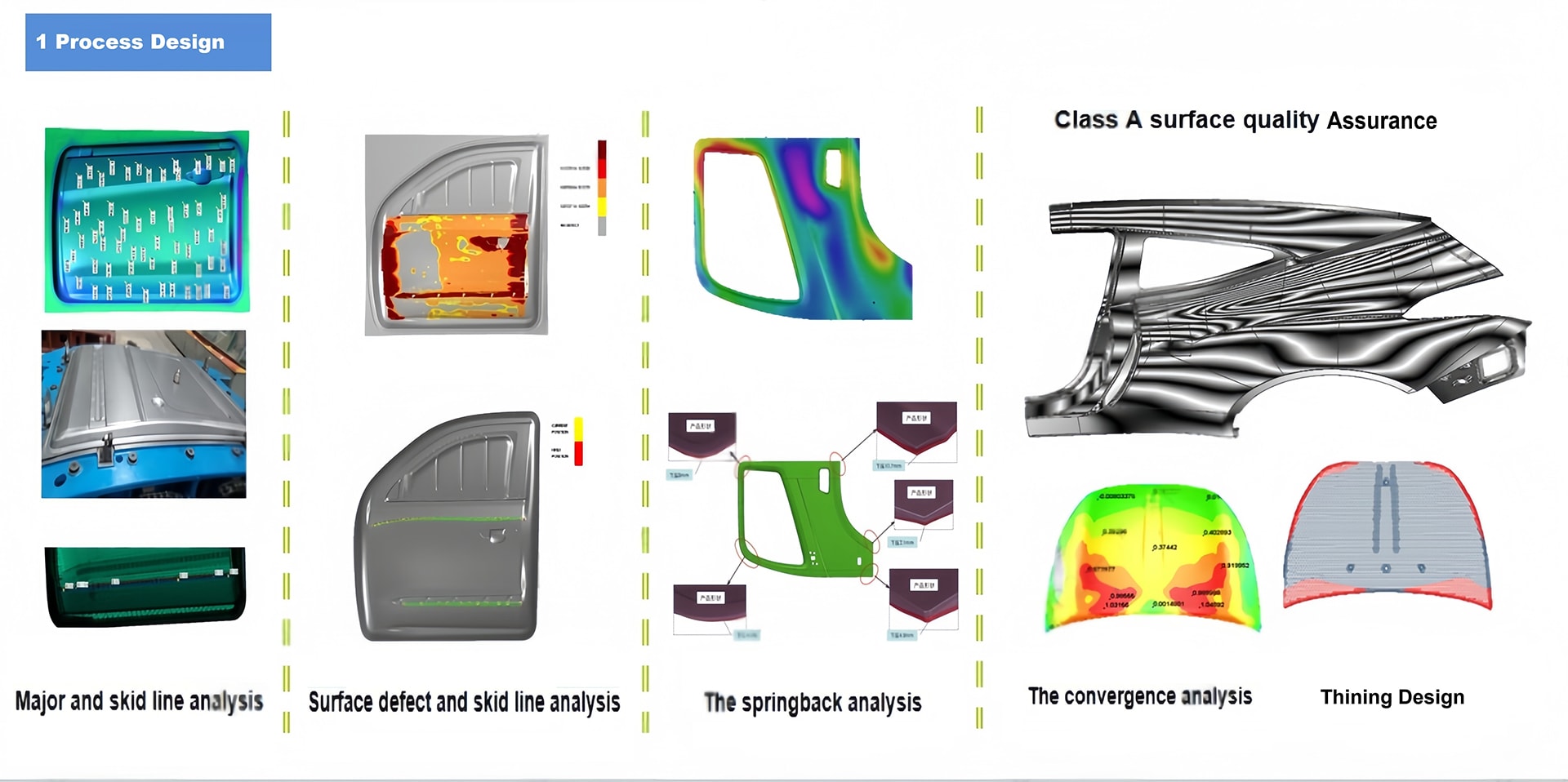
01. Die Design Capabilities
HOVOL's die design team integrates concurrent engineering workflows with world-class CAE/CAD/CAM toolchains, enabling fast iteration from concept to production-ready tooling while minimising engineering change orders.

Core Engineering Competencies
- Concurrent die engineering — design, feasibility & DFM in parallel
- Full stamping feasibility analysis (springback, thinning, splits)
- Press-line simulation & die synchronisation studies
- Full-perimeter press tooling — hood, door, fender, roof, floor
- Complex geometry: Class-A surface forming & high-strength steel
- A-surface final approval & blue-light scanning sign-off

Validation & Sign-Off
- Virtual try-out with full press stroke simulation
- Force/tonnage curves matched to press capacity
- Lubrication, draw-bead & blank-holder strategies
- PFMEA integration at process-design stage
- OEM PPAP/PSW-ready documentation package
02. Stamping Process Planning
Rigorous process planning is applied from the earliest programme stages, delivering stable, repeatable production processes that meet OEM SPC requirements from first-off production.
| ±0.3 mm | Cp ≥1.67 | 100% | -25% |
| Panel Gap/Flush Tolerance | Process Capability Target | Virtual Try-Out Coverage | Tryout Iterations vs. Industry Avg. |
Process Definition
- Draw-develop-trim-flange process sequencing
- Addendum & binder optimisation for material yield
- Blank nesting & scrap reduction strategy
- High-strength & ultra-high-strength steel (UHSS) routes
- Aluminium & multi-material panel forming
Validation & Sign-Off
- Virtual try-out with full press stroke simulation
- Force/tonnage curves matched to press capacity
- Lubrication, draw-bead & blank-holder strategies
- PFMEA integration at process-design stage
- OEM PPAP/PSW-ready documentation package
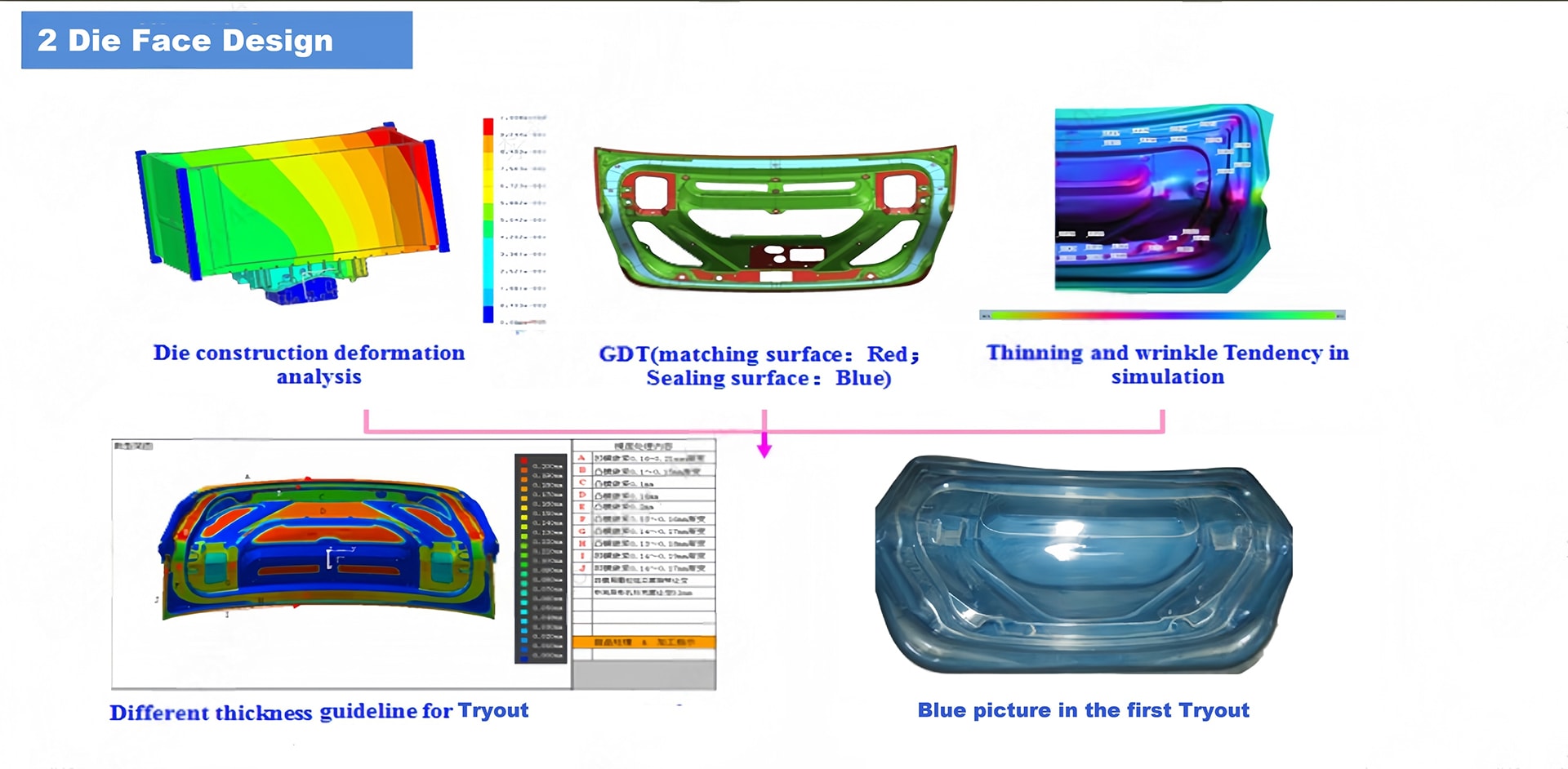
03. Die Face Engineering
Precision die face engineering is the cornerstone of surface-quality performance. HOVOL's proprietary workflows reduce physical spotting time by up to 40 %, protecting programme launch schedules and reducing tryout cost.
Die Face Development
- Addendum engineering to control springback & warp
- Binder surface topology optimised via FEA feedbackloops
- GD&T sealing-surface analysis (blue-light vs. nominal)
- Thinning & wrinkle tendency mapped in simulation
- Draft angle & parting-line negotiation with styling
Business Benefits
- Up to 40 % reduction in physical spotting cycles
- Fewer engineering change orders post-tool build
- Class-A surface quality achieved in fewer iterations
- Earlier customer sign-off — protects SOP dates
- Consistent die-face standards across global supplier base
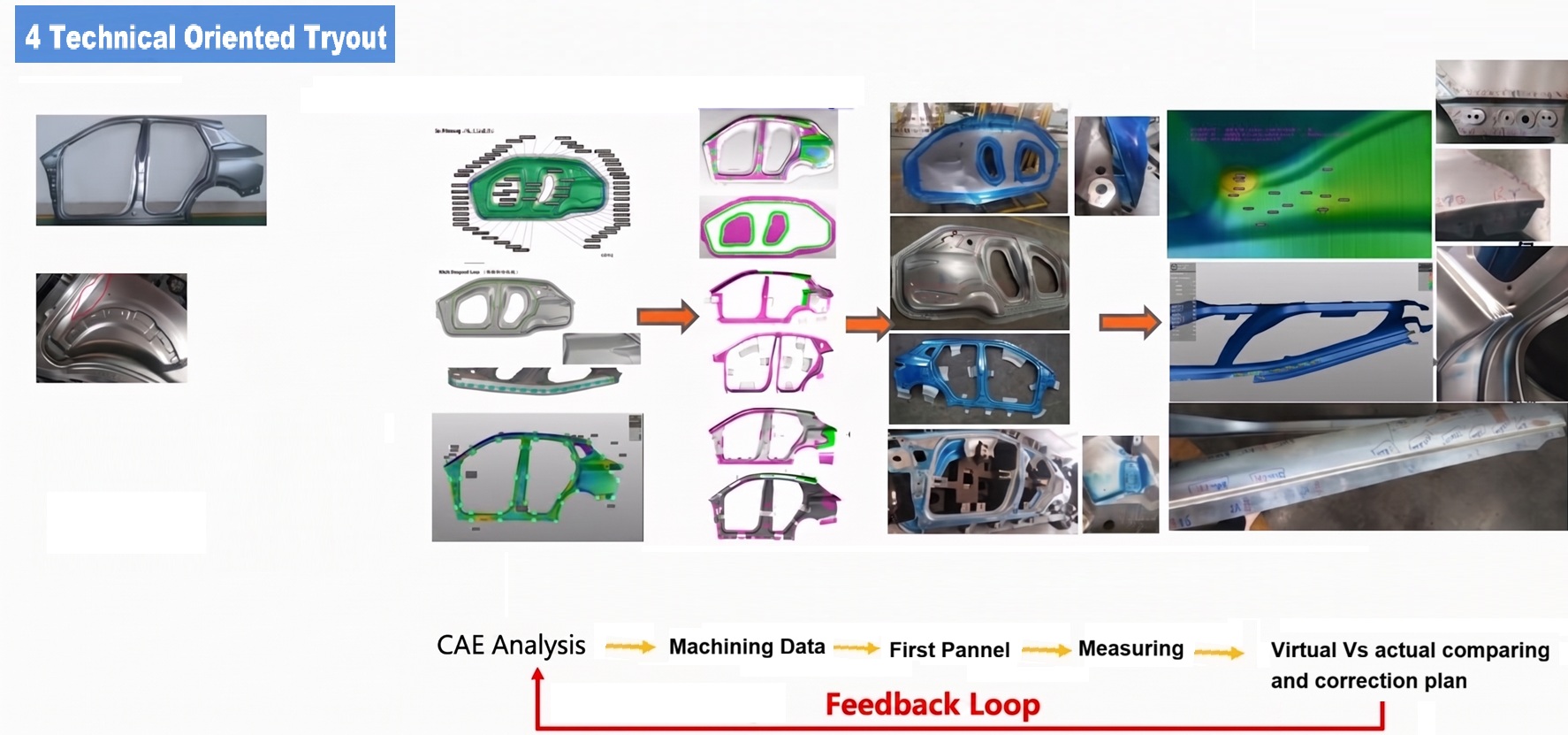
04. Interference Checking · Surface Quality · Deformation Analysis
Precision die face engineering is the cornerstone of surface-quality performance. HOVOL's proprietary workflows reduce physical spotting time by up to 40 %, protecting programme launch schedules and reducing tryout cost.
| Static Interference Check | Full 3-D collision detection across all die components at BDC/TDC | Zero tooling damage at first press trial |
| Dynamic Stroke Simulation | Time-step motion study of upper/lower die through full press cycle | Confirms clearance at every stroke position |
| Die Deflection Analysis | FEA structural simulation of die casting under full press tonnage | Prevents panel waviness; maintains surface tolerance |
| A-Surface Quality Gate | Blue-light scan overlaid on nominal CAD; deviation heat-map reporting | Objective, data-driven customer approval process |
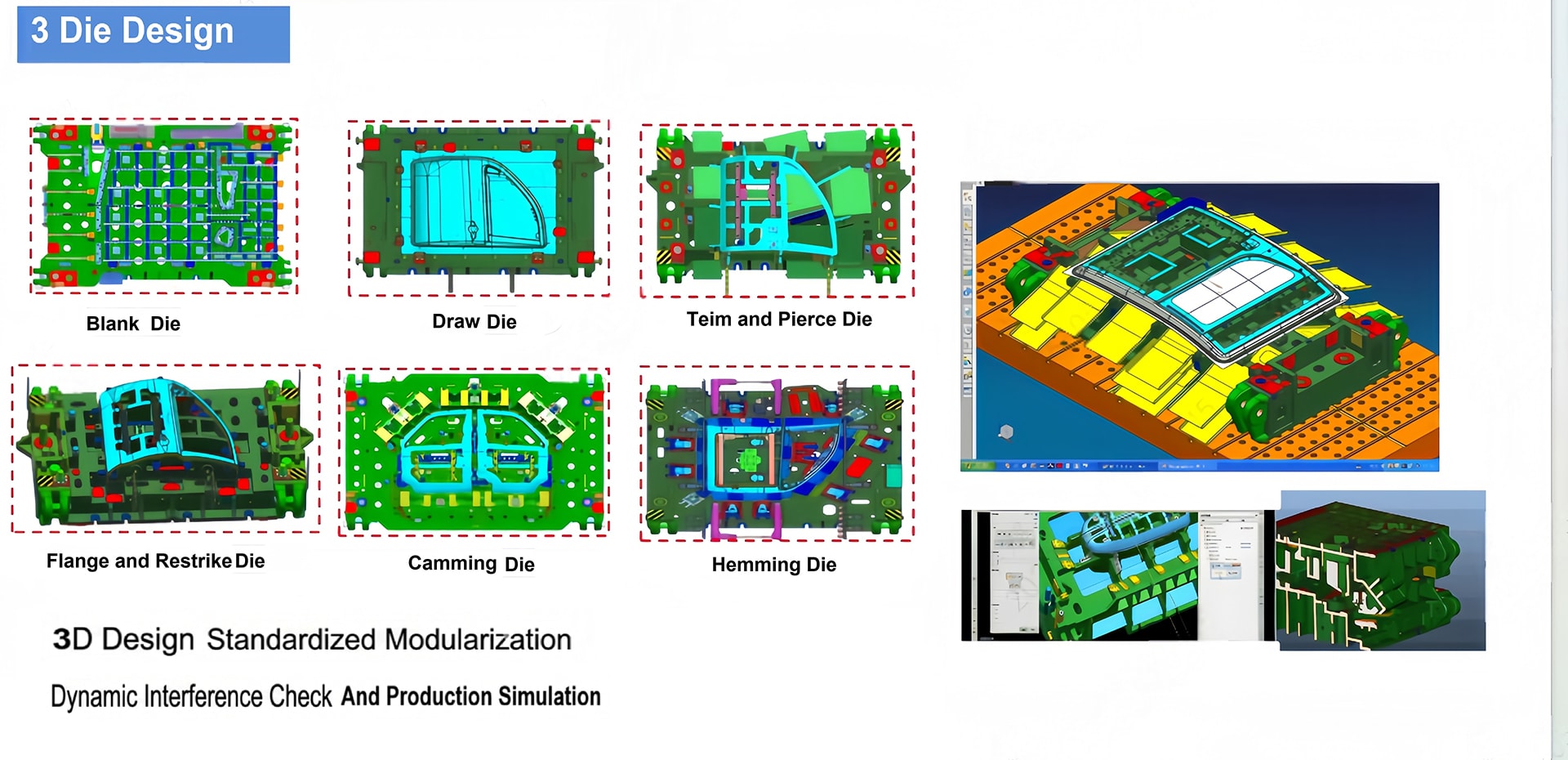
05. Structural Standardisation & Modular Design
HOVOL's modular die architecture aligns with leading OEM platform strategies, enabling rapid adaptation, cost sharing across programmes, and simplified maintenance for press-shop operators.
Modular Component Library
- Drawing Die — standardised addendum & binder geometry
- Trimming Die — interchangeable blade & scrap-chute modules
- Flanging Die — configurable cam and restriking units
- Camming Units — unified actuation with position feedback
- Springback Die — dedicated restrike stations
- Piercing Die — rapid punch/die insert change system
Value to the Customer
- 30–50 % faster engineering on derivative programmes
- Reduced spare-parts inventory for press-shopoperators
- Interchangeable modules support flexible manufacturing
- Consistent GD&T datum strategy across the tool family
- Easier PPAP re-qualification on carry-over modules
- Supports OEM Lean/TPM press-shop improvement goals